Why Do People Do the Marriage Ceremony Again Even Though They Are Not Divorced
D amian Robinson knew it was a cliche to propose to his partner, Amanda, on Christmas Solar day 2015, but he did it anyway. "I just sat down next to her on the couch, and handed her the band," the 49-year-erstwhile construction worker from Warrington remembers.
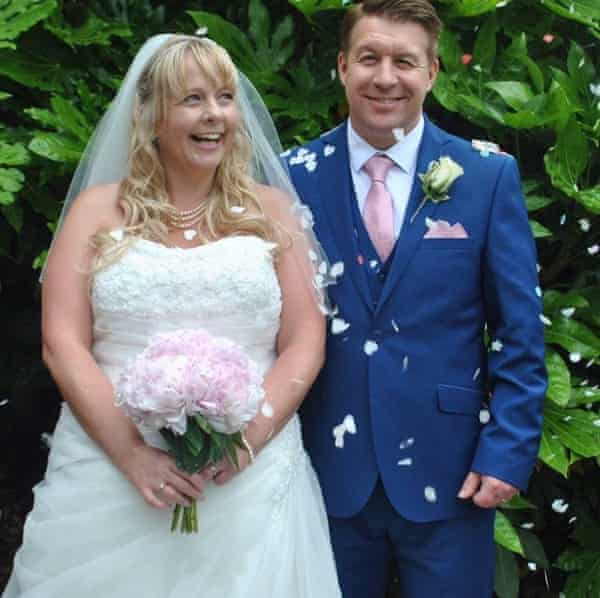
They wed at a register office in Prescot, near Liverpool, in August 2017. The anniversary was small – close family unit and friends – and Damian read a Pablo Neruda poem. It was especially nice having Damian's nephew Sam there, every bit a reminder of their unique dear story. Because Sam had been there the offset fourth dimension Amanda and Damian got married, in July 1994. Dorsum and then, Sam was a scamp of a male child, dressed in a sailor adjust. This time around, he was their best human.
Marrying the aforementioned person twice isn't the sort of affair you lot associate with Prescot register offices – it is a celebrity business. Liz Taylor and Richard Burton are the about famous example, merely in 2013 the tech billionaire Elon Musk and the British actor Talulah Riley did the same. Natalie Woods, Elliott Gould and Rosemary Clooney all remarried former partners. In 2015, Felicity Kendal divulged that she was back with her second husband, the director Michael Rudman, earlier ruling out marrying him once more.
Despite these high-profile cases, the phenomenon of couples divorcing and remarrying is so rare that information does not exist on its prevalence. "When you talk nigh divorces, some people don't even want to talk to each other afterwards!" says Dr Nancy Kalish of California State University. An adept on rekindled romances, Kalish tells me that reconnecting with a lost love – only not someone you were not married to – is more common, peculiarly equally social media makes it easier to go in touch with sometime flames. "There'southward always someone who knows someone who has washed it," says Kalish, estimating that one person in 100 will requite a lover from long agone a second shot.
"Never in a one thousand thousand years did I remember nosotros would end upwardly back together," says 45-year-old Jen Brimacombe, from Plymouth. She is in loftier spirits, having just returned from a delayed honeymoon with husband Davide to Fuerteventura. They remarried in 2017, on what would have been the 25th ceremony of their outset wedding ceremony.
Jen and Davide met through friends soon before Jen's 16th birthday. "We were in a park and he put on his friend'due south hat. I said: 'Oooh, you look like Jason Donovan!'" Jen quickly became pregnant with sons Matthew and Luke. Over the next few years, they clashed well-nigh the predictable things you lot would expect the broke young parents of toddlers to contend nearly: coin, childcare and chores. "He'd go out with his friends, and I'd be left at dwelling with the kids."
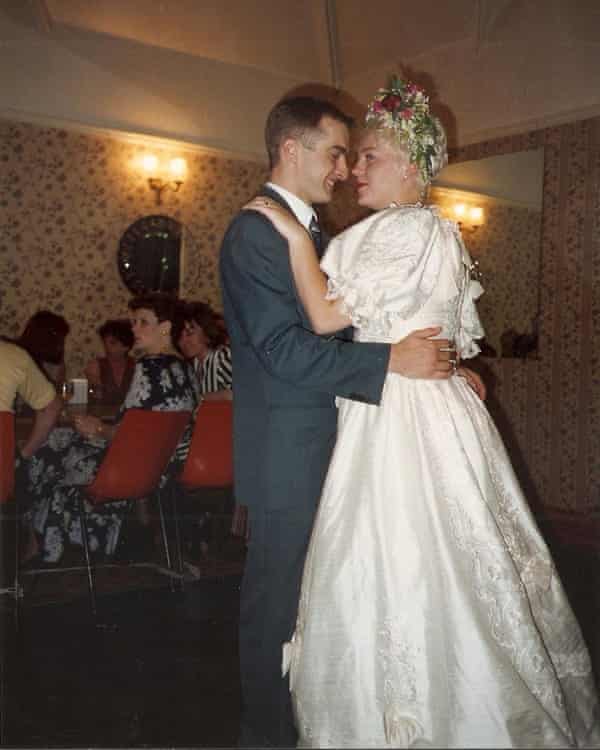
Determined to brand a become of things, they married in 1992, but separated in 1995, three weeks before Jen gave birth to their daughter Coral. Information technology was a drawn-out breakup: although they divorced in 1997, information technology wasn't until 2000 that Jen finally cut contact. "We had a row over something really stupid, and I just thought: I'chiliad non doing this any more. I've had enough."
In 2009, Davide drove Jen and Coral to a parents' evening. In the backseat, Coral must have wondered why her parents were getting on and so well – they didn't cease talking, not even subsequently Jen invited Davide in for a cuppa and a three-hr long conversation. A few days later, they went for a bulldoze on the Moors. Davide confided that his 2d wedlock was over, and he still had feelings for Jen. "I was like, oh my God, something can finally happen. There is a take chances. Something can happen now," Jen remembers.
Wellness and money bug devastated Damian and Amanda's first marriage. Later on meeting at the supermarket where they worked in St Helens, they married at the age of 25 and 22 respectively, and had two daughters. Only Amanda became frustrated that Damian wasted coin on frivolous purchases – one time he bought a drove of xx DVDs – and Damian was wearied from taking on the bulk of the housework and childcare, equally Amanda had dorsum bug.
Mutual resentment congenital up. They divorced in 2006, and fought each other in the family courts. "The bitterness was mainly from me," Damian admits. Amanda had a son earlier separating from her new partner. In 2011, Amanda'due south two-twelvemonth-old son was hospitalised, and Damian went to visit them in Warrington Hospital. In the fluorescent chill of a infirmary corridor, their love spluttered and sparked back into life. "She was upset and worried about her son," Damian remembers. "I merely held her hand." When Amanda squeezed it dorsum, Damian "felt indescribably happy". From that one manus-hold, they reconciled.
Damian and Amanda match the profile of the couples Kalish has studied who reunite after years autonomously. "They split up for situational reasons, and when they get back together those reasons aren't at that place any more than," Kalish summarises. Children are grown upward; coin is not so tight. The slings and arrows of everyday life no longer rain downwardly on them in the same fashion. "Every day turned into a chip of a grind," Damian recalls. "You lot get worn downward, and it starts spilling out into frustration with each other. You forget why you were together in the first place. Everything is a chore."
When we retrieve of the things that drive lovers apart, it is often the grand betrayals: adultery, addiction, corruption. But more typically, it is the vicissitudes of daily life. Jobs lost unexpectedly; unplanned pregnancies. Or the smaller things: cross words over undone dishes. A DVD drove y'all tin't afford.
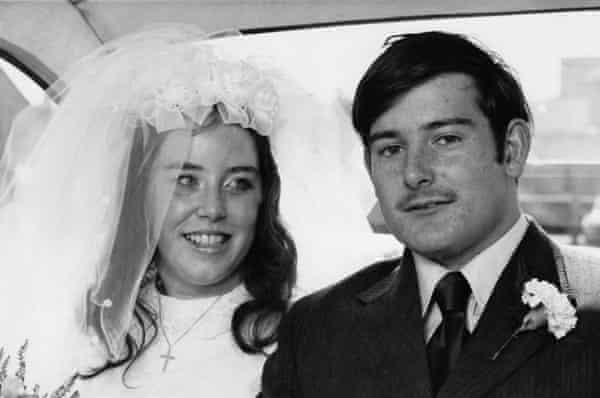
Non all relationships founder in the rock-filled waters of money woes and childrearing. Extramarital diplomacy are a common unforced mistake. When Chris Craik, 65, from Newcastle upon Tyne, met Dee in 1970, information technology was love at first sight. They married in 1972 and had two children. Simply Chris worked long hours as an RAF technician, and Dee was preoccupied with the kids. "We were moving in reverse directions. She was maternal; I worked long hours. I would become domicile, and she would be tired from the children." He had an affair, and was caught climbing a fence in married quarters. In 1979, Dee moved back to Newcastle with the children.
Nearly immediately, Chris realised he had made a catastrophic mistake. He begged Dee for another take a chance. She agreed, but only if he could move to Newcastle to be with his family. Chris asked his commanding officeholder for a transfer, but it was denied. Life ebbed and eddied away. Both remarried; Chris returned to his native Commonwealth of australia in 1983.
A common theme in these stories of love lost and regained is the presence of children binding former partners together. When a cataclysm should befall them – a toddler sick in the hospital, or the grief of losing a son – the parents lurch dorsum into each other's arms. In 2009, Chris and Dee's son died unexpectedly following a stroke. In their grief, they began talking again. Chris relocated to the UK to exist closer to his daughter, divorcing his second wife in the process. Spending more than time with Dee confirmed what Chris had suspected: divorcing her had been the greatest mistake of his life. "We were both so young when we went through the divorce. I was very headstrong. I thought: information technology's easier to get a divorce."
As Dee had remarried, Chris kept his distance. But in 2011, his daughter told him some momentous news: Dee and her second husband were separating. "She said: 'Don't go there!' I said: 'What practise you mean?' She said: 'I can encounter. You expect at Mum, and I tin see. Don't you lot go anywhere near her until it's all done and dusted,'" Chris chuckles. They reunited subsequently that yr.
If yous believe our personalities are immutable, it is hard to explain why some couples become a do-over. Surely the issues that tanked your relationship the first time around will scupper it again? But the passage of time causes people to mellow. Tempers don't flare up like before.
Damian says: "The five years we'd spent apart, I'd learned to become a ameliorate person. With maturity comes patience and tolerance. We probably understand and appreciate each other'south needs a lot more now." Chris is likewise self-critical. "I wasn't really a squeamish person, the outset time effectually. And dorsum so, Dee was very tranquility and passive. The 2nd fourth dimension around, I'd grown up and got a bit softer, and Dee had got more assertive, and confident with dealing with me. We just blended straight away."
Those who accept been given a second take a chance at lost love know not to take anything for granted. You accept to work at relationships; a piddling bit every day. Damian does Amanda's ironing and brings her cups of tea in the morn without grumbling. "I'm far more appreciative of her now and volition practice things for her without even thinking."
But not all second chances have moving-picture show-postcard happy endings. The ragged, impersonal contours of fate may throw your love back into your life for a while, before wrenching them abroad. After reconciling, Chris and Dee spent v happy years together. They holidayed away, and had engagement nights looking subsequently their grandchildren.
In January 2016, Chris decided to surprise Dee by proposing to her the following calendar month, on her birthday. He commissioned a replica of her wedding ring from a local jeweller. (She had sold the original, when times were hard.) The ring was still being fabricated when Dee began complaining of a headache 1 Sun evening in bed. She went to the bathroom to be sick. Chris heard her slump to the floor. "She looked upwardly at me, and the lite just went out of her optics." Dee died the post-obit morning from a stroke.
It was a trunk blow. "I got so close to having it all again, and information technology was all snatched away," says Chris. "I was a very angry man for about six months." In time, Chris felt grateful that he had known Dee once more, fifty-fifty briefly. "I got a 2d chance. How many guys get that, a second chance with their first love? And it was absolute, pure delight. The whole v years we spent together was perfect."
These existent-life stories of love lost and found once again tin can teach united states lessons virtually change, romance and the means in which the grind of daily life can whittle once-muscular relationships down into nubs of bone. They are as well, in their own style, enormously uplifting. Because who doesn't desire to believe that – subsequently years spent apart and crossed words and blazing rows – love might notice a style?
At Dee's funeral, Chris handed out her favourite Corinthians poesy. Love is patient. Beloved is kind. Beloved is not grumbling about the housework, or DVD collections, or climbing fences in married quarters. Chris's communication for couples contemplating reuniting is simple. "Have a crack at information technology. But you've got to change. You have to consider the other person's point of view, every time. That'southward what love is nearly. It's about listening."
Chris ended up having Dee's ring made anyway, as a family heirloom. It is a reminder of love lost, and institute, and lost again, and how all things are possible – if you lot are willing to change.
Source: https://www.theguardian.com/lifeandstyle/2019/aug/13/second-chance-first-love-meet-couples-marry-divorce-remarry
0 Response to "Why Do People Do the Marriage Ceremony Again Even Though They Are Not Divorced"
Post a Comment